Consider following my work on Patreon, where the free tier unlocks everything. Models, Workflows, Research, Process.
Watch a deep dive of the training process here
A year ago, I released version 3, and was surprised to see the volume of both support and criticism. I still stand by my belief that we can not only take control of the technology's potential by training on our own imagery, but also that we can bring an empowering version of the post-AI-visual-sphere into realization through publishing tools made by individuals, not just corporations, and that are accessible to anyone with a laptop, not just those with industy credentials or formal education. The democratic nature of free, open-source tools will inherently create a lot of slop, but I feel expanding the reach of any medium is a net positive.
You can support me on Patreon and get everything for free :)
https://www.patreon.com/CalvinHerbst
Aesthetic Properties of the model:
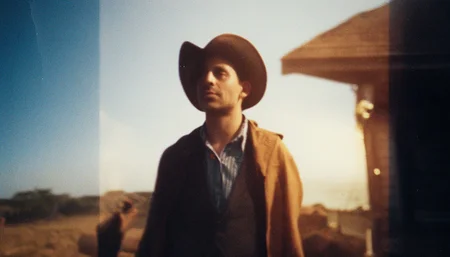
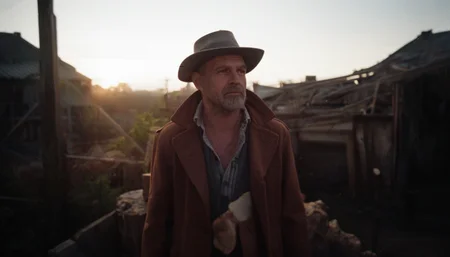
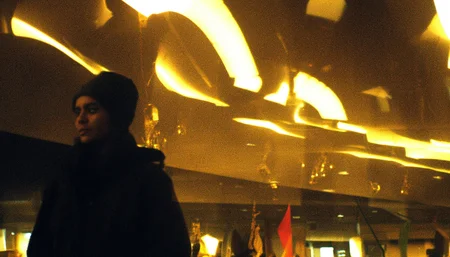
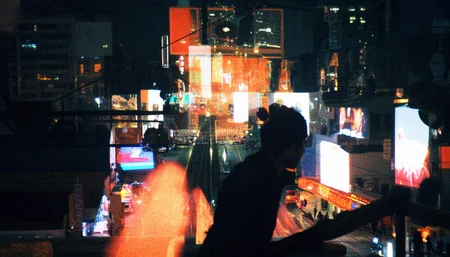
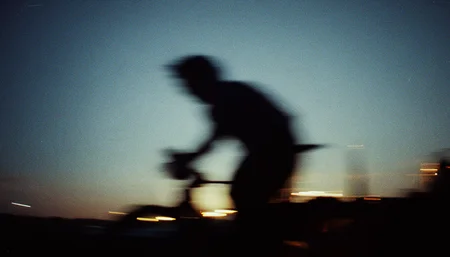
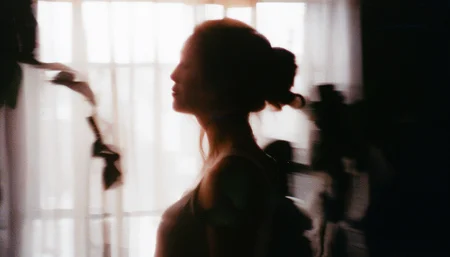
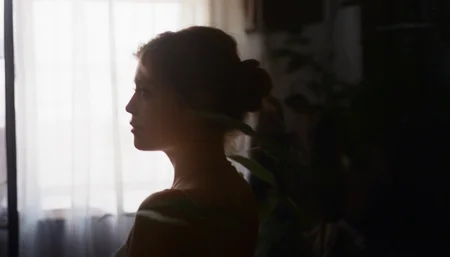
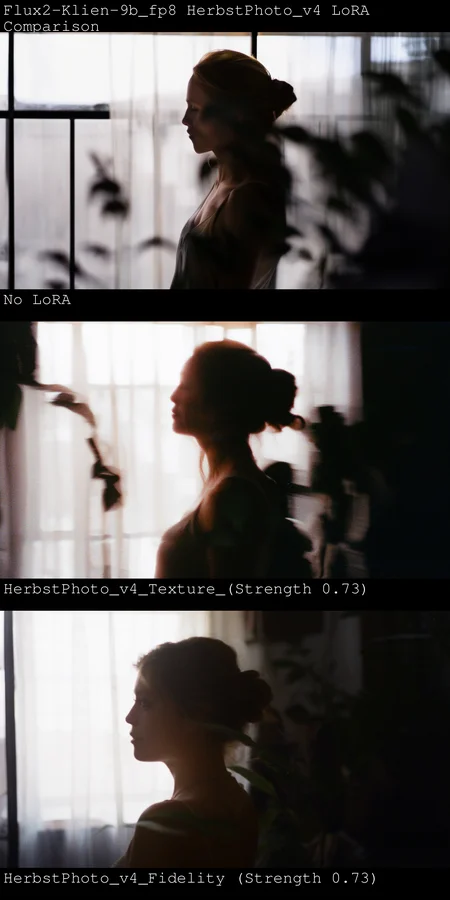
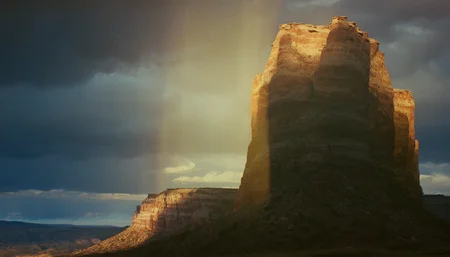
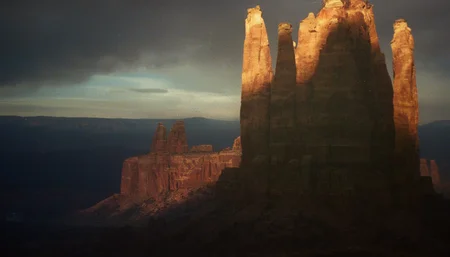
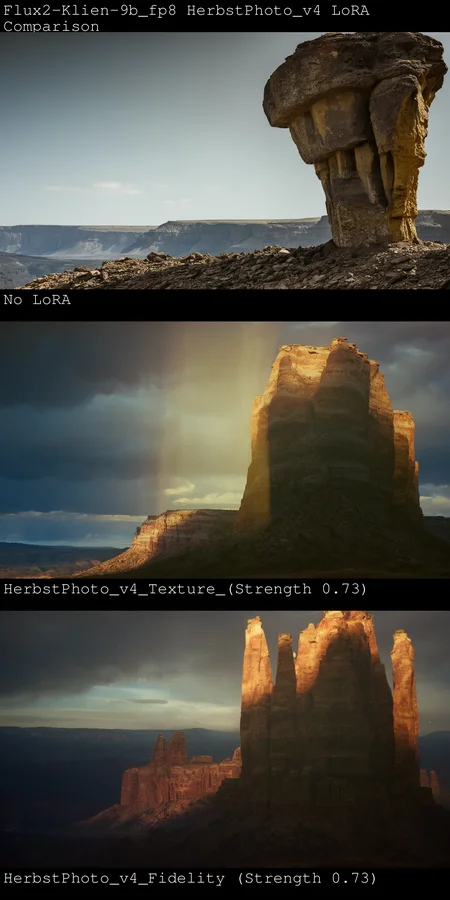
HerbstPhoto_v4_Flux2 produces intensely imperfect images that feel candid and alive. The model creates analog degradation micro-textures that break past the plastic look by introducing filmic softness, emulsion bloom & hailation, optical artifacts - such as lens flares, light leaks, chromatic aberration, barrel distortion - and grain that behaves naturally across exposure levels. Compositions are moody and take form in chiaroscuro light, with dark regions that blanket the frame to create asymmetry and bright slivers that form hotspots to maintain balance. The contrast curve is aggressively low latitude, embracing clipped highlights and crushed shadows, while preserving a high black point to feel true to the celluloid nature of the images the model was trained on.
Version 4 is trained for Flux 2 Dev from @Black Forest Labs because I beleive it’s the best image diffusion model, however it’s a heavy and can take several minutes to generate a single high-res image, so I will also be releasing an updated version for Z-image, Flux 1 Dev, and SDXL in the coming weeks for those who are looking to use less compute or create faster.
Best Practices using the model:
Prompts: Include “HerbstPhoto” in the prompt. Though the Flux 2 Model can handle prompts that are long and complex thanks to its incorporation of the minstral_3_small_fp8 text encoder from @Minstral AI I tuned this LoRA to produce dramatic effects even with simple language writing that does not include style, texture, and lighting tokens.
LoRA strength: 0.4 - 0.75. (0.73 sweet spot) 0.8-1.0 for less prompt adherence and max image texture/degradation.
Resolution: 2048x1152, though the model also produces good results across aspect ratios and sizes up to 2k.
Schedulers and Samplers: I tested every combination of Schedulers and Samplers for Flux 2 (378 total) and can recommend a handful of combinations that I tested on a Pro 6000 WK GPU @ 1024x1024 @ 20 steps that each have different aesthetics and render speeds.
dpmpp_2s_ancestarl + sgm_uniform: Best balance of texture & fidelity. 160 sec. Render
er_sde + ddim_uniform: Good balance of texture & fidelity. 60 sec. render
dpmpp_sde + simple: Softer focus, lower contrast, less artifacts, brighter. 130 sec. Render
dpmpp_3m_sde_gpu + simple: higher contrast, brighter, more chromatic aberrations. 60 sec. render
Ipndm + simple: Higher clarity, less softness, fewer artifacts, cooler. 60 sec. render
dpmpp_sde + ddim_uni: higher saturation, color shifting. 130 sec. Render
Training Process Overview:
I used AI Toolkit from Ostris on an H200 GPU cluster from Runpod to train over 100 versions of the model, all using the same dataset + simple captions. For each run, I changed one parameter to get a clean A/B tests and figure out what actually moves the needle. I’ll share the full research soon :) After lots of testing, I am happy to finally release HerbstPhoto_v4_Flux2.
Coming soon:
HerbstPhoto_v4.1_Flux1Dev
HerbstPhoto_v4.2_ZImage
HerbstPhoto_v4.3_SDXL
HerbstPhoto_v4.4_Flux2_DarkAbyss
HerbstPhoto_v4.5_Flux2_FishEye
HerbstPhoto_v4.6_Qwen_ImageEnhancer
Description
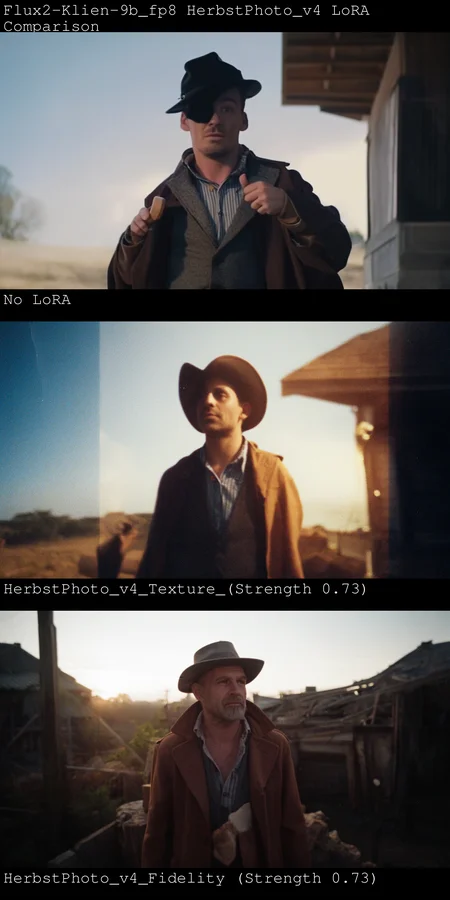
Two Versions of the Klein model are Available:
v4_Texture - Heavy grain, higher contrast, highlight bloom, soft focus, underexposure, frequent lens flares and light leaks
v4_Fidelity - Better subject retention, milder film characteristics, more consistent results
Recommended Settings:
Base model: flux2-klein-base-9b-fp8
Trigger word: "HerbstPhoto"
Resolution: 1344x768 (range: 1024x576 to 2304x1156)
LoRA strength: 0.73 (range: 0.4-1.0)
Flux Guidance: 2.5 (range: 2.1-2.9)
Sampler: dpmpp_2s_a + sgm_uni
Denoise: 1.0 (0.6-0.9 for img2img)
Important Note on Seeds: The fp8 version has higher seed dependency - you may need 5-10 generations to find a good seed. The non-fp8 klein-9b has better seed consistency but less authentic film grain texture.
Training Data: Trained exclusively on my personal analog photography that I own the rights to.
FAQ
Comments (6)
Does this also work on the distilled versions of the models?
It works the best on the distilled models strangley enough. The full Klein 9b version has more seed stability but the textures and image aestehtic is the best when using the 9b-fp8-base version of the model. You will probably have to make 10+ runs to get a good seed with the fp8. The klien model in general struggles with multi-subject group shots or full body character shots so write prompts that are 1-2 people waist up for the best results. If you post an image with it consider givine me or the lora tag :) @calvin_herbst on instagram
Any plans for Z Image Turbo or Flux 2 klein Distilled?
Thank you, :) Yes, I will absolutely. At the moment, I'm working on publishing models that I have had on the shelf but once I'm caught up in the coming weeks, I will begin new training projects. I also have started to publish the training documentation on my Patreon (everything is inlcuded with the free membership). If you are into it, consider checking it out: https://patreon.com/CalvinHerbst?utm_medium=unknown&utm_source=join_link&utm_campaign=creatorshare_creator&utm_content=copyLink
Where is the 'v4_Fidelity' version?
Hey there, was a bug but its back up now.