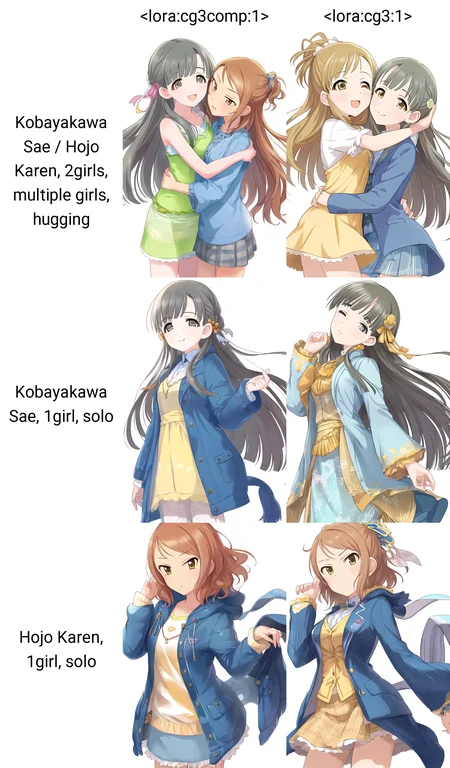
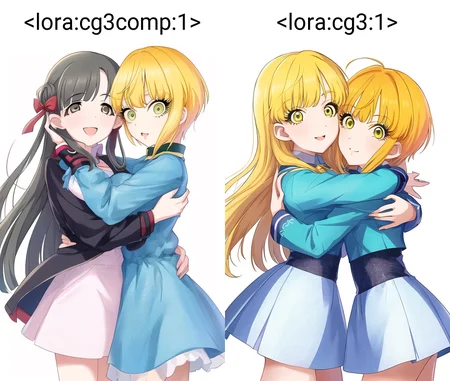
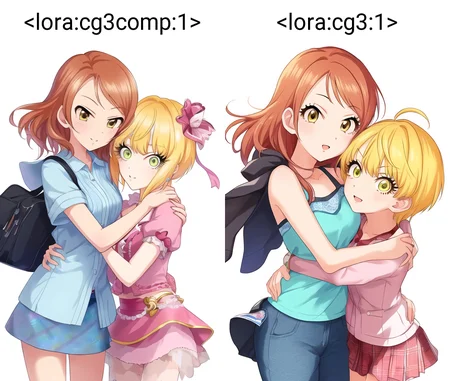
Updates will be mirrored on both Hugging Face and Civitai.
Introduction
It has been shown that multiple characters can be trained into the same model. A harder task is to create a model that can generate multiple characters simultaneously without modifying the generation pipeline. This document describes a simple technique that has been shown to help generating multiple characters in the same image.
Method
Requirement: Sets of single-character images
Steps:
1. Train a multi-concept model using the original dataset
2. Create an augmentation dataset of joined image pairs (composites) from the original dataset
3. Train on the augmentation dataset
Experiment
Setup
3 characters from the game Cinderella Girls are chosen for the experiment. The base model is anime-final-pruned. It has been checked that the base model has minimal knowledge of the trained characters. Images with multiple characters were removed (edit: after training it was found that some unrelated background characters were not removed).
For the captions of the joined images, the template format CharLeft/CharRight/COMPOSITE, TagsLeft, TagsRight is used.
A LoRA (Hadamard product) is trained using the config file below:
[model_arguments]
v2 = false
v_parameterization = false
pretrained_model_name_or_path = "Animefull-final-pruned.ckpt"

[additional_network_arguments]
no_metadata = false
unet_lr = 0.0005
text_encoder_lr = 0.0005
network_module = "lycoris.kohya"
network_dim = 8
network_alpha = 1
network_args = [ "conv_dim=0", "conv_alpha=16", "algo=loha",]
network_train_unet_only = false
network_train_text_encoder_only = false

[optimizer_arguments]
optimizer_type = "AdamW8bit"
learning_rate = 0.0005
max_grad_norm = 1.0
lr_scheduler = "cosine"
lr_warmup_steps = 0

[dataset_arguments]
debug_dataset = false
# keep token 1
# resolution 640*640

[training_arguments]
output_name = "cg3comp"
save_precision = "fp16"
save_every_n_epochs = 1
train_batch_size = 4
max_token_length = 225
mem_eff_attn = false
xformers = true
max_train_epochs = 40
max_data_loader_n_workers = 8
persistent_data_loader_workers = true
gradient_checkpointing = false
gradient_accumulation_steps = 1
mixed_precision = "fp16"
clip_skip = 2
lowram = true

[sample_prompt_arguments]
sample_every_n_epochs = 1
sample_sampler = "k_euler_a"

[saving_arguments]
save_model_as = "safetensors"
For the second stage of training, the batch size was reduced to 2 and the resolution was set to 768 * 768 while keeping other settings identical. The training took less than 2 hours on a T4 GPU.
Results
(see preview images)
Limitations
This technique doubles the memory/compute requirement
Composites can still be generated despite negative prompting
Cloned characters seem to become the primary failure mode in place of blended characters
Can generate 2 characters but not 3 for some reason
Related Works
Models been trained on datasets based on anime shows have demonstrated multi-subject capability. Simply using concepts distant enough such as 1girl, 1boy has also been shown to be effective.
Future work
Below is a list of ideas yet to be explored
Synthetic datasets
Unequal aspect ratios
Regularization
Joint training instaed of sequential
Description
FAQ
Comments (8)
For those who are interested, this is a paper that has explored this training technique
https://arxiv.org/abs/2303.11305
P.S. Sorry for repeated posting, but I did not notice that you already put this on civitai.
I dont know whether it's better than " latent couple",but create a model for yuri cp only sounds good,,haha
You can use the two together. It is much easier to use a model that already knows how to put multiple characters together with latent couple.
I'm aware of similar methods such as regional prompter or multidiffusion but IMO these feel like hacks and can't do perspective or interactions well. The goal here is to use concepts in a way that can't be clearly region-separated (hence the hugging example). Also not modifying the pipeline means less effort and more diversity.
So is this what "girlpack" creators are using? Those make multiple characters in a single lora/lycoris? Or is this different?
AFAICT girlpacks (SysDeep's models) just have single-subject images in the dataset without any extra processing. Those are easy to make but can't do multi-subjects. Try putting 2 trained characters in the same image and you'll see the point of this post.
Been trying to understand this guide for a couple weeks now.. what do you mean by joined image pairs? are these images generated from the LORA made in the initial training, or do they consist of both characters photoshoped together?
That's making combined images by sticking pairs of images together side by side. I used ImageMagick for that, but any appropriate tool would do. I used image from the original dataset (sampled some random pairs). I suppose you can use generated ones as well.