


V1.6 FP8 released
This is an experimental quantization weight implemented by scaling the maximum value in V1.6 to run on low GPU memory.
Recommended for use with Qwen-Image-Edit-2511-Lightning-4steps-v1.0-fp32.
Suggested sampler: Euler + Simple
🤯🤯 2026-01.01 Happy New Year - V1.6
V1.6 reduces the NSFW LoRA components and adds F2P LoRA.
Based on testing:
Improved facial consistency.
More harmonious female body proportions.
Tested and performs well for body solo display, oral sex, doggy style, cowgirl, missionary, masturbation, titjob, and footjob (except anal).
Anime generation may still show a mismatch where characters appear 2D while scenes appear 3D; please be aware when generating anime images.
Workflow download
v1.6
v1.2
v1.5
## 🔄 Update Log / Changelog
2025.12.31
I take back what I said yesterday. The bf16-no-lightning version of v1.5 performed unsatisfactorily. It seems that the model encountered problems even with just 20 steps of raw image processing, and the quantized and accelerated model naturally inherited these issues.
I've decided to focus my work on optimizing v1.6.
abliterated will mainly include three types of weights:
An original FP16/BF16 version
An original FP8 quantized version
An FP8 & 4steps version
2025.12.30
Based on community feedback and suggestions, future releases of qwen-image-abliterated will mainly include two types of weights:
An FP16/BF16 version
An FP8 quantized version
Considering that Lightning (acceleration) lora may negatively affect users who require more fine-grained image generation, future versions will no longer integrate acceleration LoRAs into the base model by default.
If faster inference is needed, users may add acceleration lora nodes manually.
That’s all.
At present, v1.5-bf16-no-lightning is being uploaded, and v1.5-fp8-no-lightning will follow.
The v1.6 version is currently in preparation.
Current known issues:
Facial consistency shows a bias toward Caucasian features
Anime image generation exhibits an overly 3D-like appearance
Exaggerated expressions in side-view generations, possibly related to LoRAs
Unesthetic limb proportions, such as short legs or short arms
The generated image has a single lens.
The error rate for limb abnormalities is much higher than in version 1.2.
These issues will be a key focus in the v1.6 iteration. We will collect and merge more LoRAs, and we also look forward to qwen-image-edit releasing an improved version.
repository Name Changed
This repository has been officially renamed Qwn-Image-Edit-abliterated. Due to Civitai's model naming conventions, the previous qwnImageEdit2509_v15Fp8mixed4step.safetensors was actually version qwen-edit-2511. Similarly, the download model names for versions v1.4bf16-4step and v1.5fp8mixed-4step have changed as follows:
qwnImageEdit2509_v15Fp8mixed4step.safetensors -> qwnImageEdit_v15Fp8mixed4step.safetensors
qwnImageEdit2509_v14Bf164steps.safetensors -> qwnImageEdit_v14Bf164steps.safetensors
It is recommended to rename them to qwen-image-edit-abliterated-v1.5-fp8-4step and... The qwen-image-edit-abliterated-v1.4-bf16-4step .
The example workflow will be available in two versions: V1.5 qwen-image-edit-2511 and V1.2 qwen-image-edit-2509.
I noticed that ComfyUI released a workflow specifically for qwen-2511, which might replace the original workflow.
🎉 V1.5 - 2025.12.29
This may be the best-performing version since its creation.
What is it?
It is built on qwen-image-edit-2511.
It offers excellent character consistency control.
It provides native FP8 quantization support, with extremely low image quality loss compared to merging weights directly into a quantized model.
It enables stable NSFW image generation and works well with both long prompts and short keyword triggers.
At the same time, its strong consistency effectively resolves the issue of yellowish or dull female skin tones, keeping them closely aligned with the original image’s skin color.
It performs effortlessly on both anime and realistic styles.
In addition, v1.5 has merged 4-step acceleration weights, allowing the use of Euler + sampler with 4 steps.
v1.4 - 2025-12.28
Status: Released
Based on my testing, v1.4 is an unstable release and shows higher randomness compared to v1.3. v1.5 is expected to be a stable release.
Improvements
💪 Created using qwen-image-edit-2511
🧑💼 Better male nude performance
Use Note
Keeping the female protagonist’s face, appearance, and bust size consistent in the image is not necessary, especially when generating images from a rear-view perspective.
The biggest difference between v1.4 and v1.3 is that v1.4 retains the instruction-following capability of qwen-2511. Both overly detailed prompts and overly sparse prompts can lead to results that do not meet expectations.
In addition, I lowered the weight of NSFW LoRAs, because qwen-2511 is extremely sensitive to these LoRAs. As a result, sexual terms that were effective in v1.3 are not as influential in v1.4.
Based on testing, v1.4 requires more detailed descriptions of female poses and male poses. When the descriptions are done well, the resulting image quality is also very high.
In summary, v1.4 requires more advanced and nuanced prompt techniques than v1.3, but it produces more precise and accurate images.
### v1.2 — 2025-12-16
Status: Released
Improvements
🎨 Improved *anime-style consistency**
🧍 More *complete and anatomically correct male bodies**
Qwen-Edit-2509-Abliterated Model Card
Despite the existence of many unreviewed LoRAs and checkpoints based on qwen-image-edit, the image quality during actual usage is still not ideal. Especially for NSFW merge-model creation, adding too many LoRAs with arbitrary weights often damages the original semantic capability of qwen-image-edit.
Let’s introduce Qwen-Edit-2509-Abliterated.
What is it?
Qwen-Edit-2509-Abliterated is a merged model created by combining the Qwen-Edit-2509 unet checkpoint with various community LoRAs. It integrates multiple NSFW LoRAs, along with functional LoRAs such as camera-angle transformation, color tone reference, and image quality enhancement. The goal is to improve Qwen-Edit’s understanding of human poses and shooting perspectives during image editing.
As its name suggests, this is a model without review mechanisms. It can generate NSFW and unreviewed content.
The model creator is not responsible for any outputs produced. Users are encouraged to use this checkpoint friendly, legally, and responsibly.
The merged model has quantized in FP8.
The model has Supports 4-step accelerated sampling.
1. About accelerator selection
When comparing merge models with similar purposes, we found that most NSFW LoRAs were originally trained on qwen-image, a model designed for image generation.
However, accelerators used for these merge models are often from qwen-image-edit.
Tests showed:
- qwen-image-edit accelerators often fail during NSFW generation
- This may result in incomplete characters or “broken images”
- Recent testing suggests that the qwen-image accelerator performs much better for LoRA acceleration than the native qwen-image-edit one
Therefore, v1.0 uses the qwen-image accelerator, though this still requires further validation.
## Some of my personal insights on LoRA merging
2. About LoRA weight selection
The LoRA weights used in merging are all kept small (usually 0.1–0.4).
This seems to preserve most of qwen-image-edit’s original semantic understanding.
In actual usage, the experience has been very good.
Have fun!
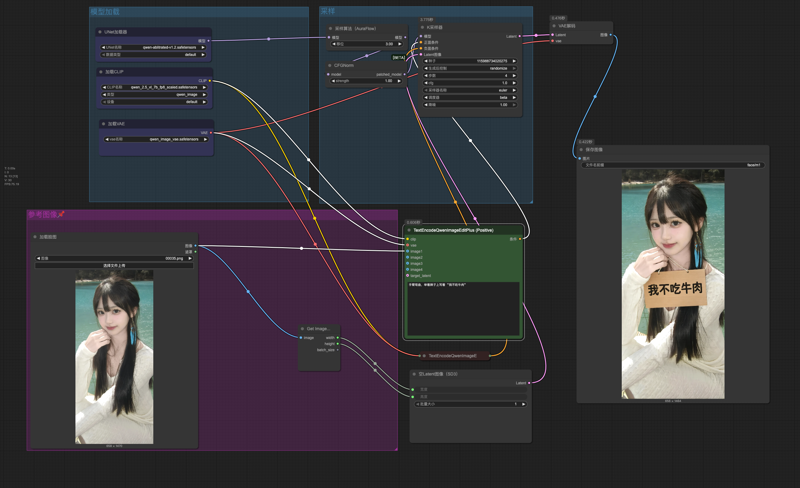
Description
A checkpoint that only incorporates NSFWlora, qwen-image-edit-2511, performs well in terms of character consistency control.
FAQ
Comments (17)
How can I use a 38GB model with 16GB of VRAM? I need help.
If you have 32 GB of RAM or more, you can use it directly, or you can convert from Safetensors to GGUF and quantize it to Q8.
@g1263495582 I have 48GB memory, and even after setting it to low VRAM mode, ComfyUI still crashes.
@907622315625 i use 1.6 ful size with this launch command --reserve-vram 6
v1.6 bf16 performs much better. Faces are consistent. It definitely produces plastic looking smooth skin though. I think that is just a problem with qwen in general..? You would think a model that is 40gigs could produce detailed and realistic skin
The qwen-image series has always had this problem: the generated portrait skin texture is unrealistic. Also, the lora I merged may also have skin color shifts.
Don't listen to OP. The problem isn't wiht Qwen but with people training it with AI generated people they generated using SDXL. It's extremely obvious, you can see the SDXL girl in all of these images. Look at Qwen images wihtout any lora integrations, or training, done by others.
It's the same with Z-Image. Z-Image looks spectacular, varied faces, great skin textures, lighting, and so on. Now, look at Z-Image loras or modified checkpoints; the quality drops signficantly because many of the trainers are obviously just throwing a bunch of SDXL related training data into it; and this fucks up everything that makes the model looks good. Instead of retraining using actual people to keep training data varied and natural,t hey train with AI generated images and this is always a bad idea. Eventually all you will generate is the same face, the same body type, the same skin textures, and good luck getting it to generate any sort of race other than asian or caucasian - it can do dark skinned versions of those two but the facial features remain clearly caucasian or asian and only one or two variants of that face at most.
@LetTheBassDrop Interesting point about being trained on generated humans. I will agree that it's not a qwen problem. I've now been experimenting with 50 steps, no lightning, lora etc, and it's amazing quality.
fp8 plzzz
v1.6 need fp8
It's not "abliterated" if you just mixed a bunch of LoRAs into it. "Abliterated" doesn't just mean "uncensored".
Yeah, this is just a merge. I am curious what results are possible if one were to actually abliberate the text encoder. I have noticed it refuses to caption some images when I use it for describing images.
"Abliterated" is a term for LLMs, not for diffusion and flowmatching models, you know
using the abliterated 8b model only good abliterated on QWEN
@snapflipper (btw?) we're about Qwen Edit itself, not the LLM
how to make it run in wan2gp? It gives me errors with my finetune json file. I tried just the large safetensor file and then also the fp8 version, the file still gives me error when launching the app.
Its a qwn model, not a wan model, wa2gp is for quant wan models only.