
Use with workflow: https://civarchive.com/models/2065461?modelVersionId=2337222
🎉 ✨ UPDATE - Version 2 Now Available! (21 Oct 2025) ✨ 🎉
🚀 New Model: next-scene_lora-v2-3000.safetensors
What's New in V2:
🎯 Trained on higher quality data for significantly improved results
💪 Better command responsiveness - the model follows your prompts more accurately
🖼️ Fixed black bar artifacts - no more unwanted black borders on generated images
⚡ Overall enhanced performance - smoother transitions and better cinematic flow
Recommended: Use V2 for all new projects.
📥 ComfyUI Workflow: https://civarchive.com/models/2065461?modelVersionId=2337222
🧠 What This Model Does
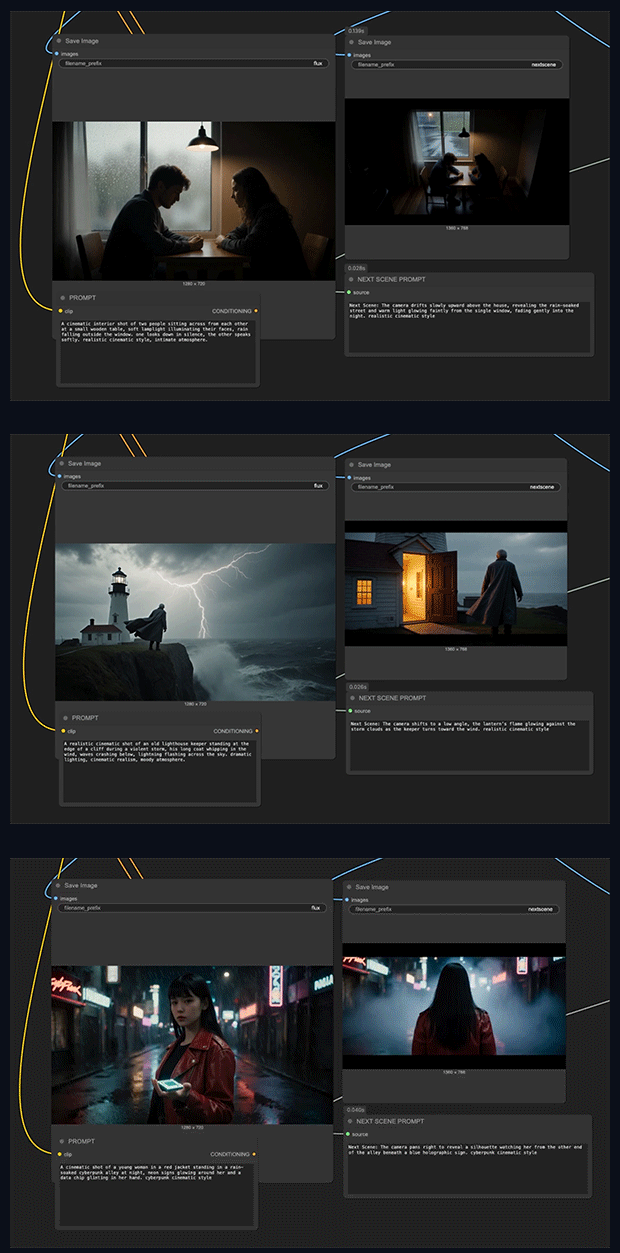
This LoRA brings cinematic storytelling continuity into AI image generation workflows.
Each output frame functions as the "Next Scene" in an evolving visual narrative, maintaining compositional coherence while introducing organic transitions such as:
Camera movement: Dolly shots, push-ins, pull-backs, and tracking moves
Framing evolution: Wide to close-up transitions, angle shifts, reframing
Environmental reveals: New characters entering frame, expanded scenery, spatial progression
Atmospheric shifts: Lighting changes, weather evolution, time-of-day transitions
Examples of Cinematic Logic:
"Next Scene: The camera pulls back from a tight close-up on the airship to a sweeping aerial view, revealing an entire fleet of vessels soaring through a fantasy landscape."
"Next Scene: The camera tracks forward and tilts down, bringing the sun and helicopters closer into frame as a strong lens flare intensifies."
"Next Scene: The camera pans right, removing the dragon and rider from view while revealing more of the floating mountain range in the distance."
______
next-scene-qwen-image-lora-2509 is a LoRA adapter fine-tuned on Qwen-Image-Edit (build 2509), purpose-built to generate cinematic image sequences with natural visual progression from frame to frame.
This model enables Qwen Image Edit to think like a film director—understanding camera dynamics, visual composition, and narrative continuity to create shots that flow seamlessly into one another.
🧠 What This Model Does
This LoRA brings cinematic storytelling continuity into AI image generation workflows.
Each output frame functions as the "Next Scene" in an evolving visual narrative, maintaining compositional coherence while introducing organic transitions such as:
Camera movement: Dolly shots, push-ins, pull-backs, and tracking moves
Framing evolution: Wide to close-up transitions, angle shifts, reframing
Environmental reveals: New characters entering frame, expanded scenery, spatial progression
Atmospheric shifts: Lighting changes, weather evolution, time-of-day transitions
Examples of Cinematic Logic:
"Next Scene: The camera pulls back from a tight close-up on the airship to a sweeping aerial view, revealing an entire fleet of vessels soaring through a fantasy landscape."
"Next Scene: The camera tracks forward and tilts down, bringing the sun and helicopters closer into frame as a strong lens flare intensifies."
"Next Scene: The camera pans right, removing the dragon and rider from view while revealing more of the floating mountain range in the distance."
⚙️ Usage Instructions
Basic Setup:
Load Qwen-Image-Edit 2509 as your base model
Add a LoRA Loader node and select
next-scene-qwen-image-lora-2509Set LoRA strength: 0.7 – 0.8 (recommended)
Structure your prompts with "Next Scene:" prefix for optimal results
Example Prompt:
Next Scene: The camera moves slightly forward as sunlight breaks through the clouds, casting a soft glow around the character's silhouette in the mist. Realistic cinematic style, atmospheric depth.
Pro Tips:
Begin prompts with camera direction for stronger continuity
Specify lighting and atmospheric changes for mood consistency
Chain multiple generations to create sequential storyboards
Works particularly well with landscape and establishing shots
next-scene-qwen-image-lora-2509 is a LoRA adapter fine-tuned on Qwen-Image-Edit (build 2509), purpose-built to generate cinematic image sequences with natural visual progression from frame to frame.
This model enables Qwen Image Edit to think like a film director—understanding camera dynamics, visual composition, and narrative continuity to create shots that flow seamlessly into one another.
🧠 What This Model Does
This LoRA brings cinematic storytelling continuity into AI image generation workflows.
Each output frame functions as the "Next Scene" in an evolving visual narrative, maintaining compositional coherence while introducing organic transitions such as:
Camera movement: Dolly shots, push-ins, pull-backs, and tracking moves
Framing evolution: Wide to close-up transitions, angle shifts, reframing
Environmental reveals: New characters entering frame, expanded scenery, spatial progression
Atmospheric shifts: Lighting changes, weather evolution, time-of-day transitions
Examples of Cinematic Logic:
"Next Scene: The camera pulls back from a tight close-up on the airship to a sweeping aerial view, revealing an entire fleet of vessels soaring through a fantasy landscape."
"Next Scene: The camera tracks forward and tilts down, bringing the sun and helicopters closer into frame as a strong lens flare intensifies."
"Next Scene: The camera pans right, removing the dragon and rider from view while revealing more of the floating mountain range in the distance."
⚙️ Usage Instructions
Basic Setup:
Load Qwen-Image-Edit 2509 as your base model
Add a LoRA Loader node and select
next-scene-qwen-image-lora-2509Set LoRA strength: 0.7 – 0.8 (recommended)
Structure your prompts with "Next Scene:" prefix for optimal results
Example Prompt:
Next Scene: The camera moves slightly forward as sunlight breaks through the clouds, casting a soft glow around the character's silhouette in the mist. Realistic cinematic style, atmospheric depth.
Pro Tips:
Begin prompts with camera direction for stronger continuity
Specify lighting and atmospheric changes for mood consistency
Chain multiple generations to create sequential storyboards
Works particularly well with landscape and establishing shots
Description
Use with workflow: https://civitai.com/models/2065461?modelVersionId=2337222
🎉 ✨ UPDATE - Version 2 Now Available! (21 Oct 2025) ✨ 🎉
🚀 New Model: next-scene_lora-v2-3000.safetensors
What's New in V2:
🎯 Trained on higher quality data for significantly improved results
💪 Better command responsiveness - the model follows your prompts more accurately
🖼️ Fixed black bar artifacts - no more unwanted black borders on generated images
⚡ Overall enhanced performance - smoother transitions and better cinematic flow
Recommended: Use V2 for all new projects.
📥 ComfyUI Workflow: https://civitai.com/models/2065461?modelVersionId=2337222
______
next-scene-qwen-image-lora-2509 is a LoRA adapter fine-tuned on Qwen-Image-Edit (build 2509), purpose-built to generate cinematic image sequences with natural visual progression from frame to frame.
This model enables Qwen Image Edit to think like a film director—understanding camera dynamics, visual composition, and narrative continuity to create shots that flow seamlessly into one another.
🧠 What This Model Does
This LoRA brings cinematic storytelling continuity into AI image generation workflows.
Each output frame functions as the "Next Scene" in an evolving visual narrative, maintaining compositional coherence while introducing organic transitions such as:
Camera movement: Dolly shots, push-ins, pull-backs, and tracking moves
Framing evolution: Wide to close-up transitions, angle shifts, reframing
Environmental reveals: New characters entering frame, expanded scenery, spatial progression
Atmospheric shifts: Lighting changes, weather evolution, time-of-day transitions
Examples of Cinematic Logic:
"Next Scene: The camera pulls back from a tight close-up on the airship to a sweeping aerial view, revealing an entire fleet of vessels soaring through a fantasy landscape."
"Next Scene: The camera tracks forward and tilts down, bringing the sun and helicopters closer into frame as a strong lens flare intensifies."
"Next Scene: The camera pans right, removing the dragon and rider from view while revealing more of the floating mountain range in the distance."
⚙️ Usage Instructions
Basic Setup:
Load Qwen-Image-Edit 2509 as your base model
Add a LoRA Loader node and select
next-scene-qwen-image-lora-2509Set LoRA strength: 0.7 – 0.8 (recommended)
Structure your prompts with "Next Scene:" prefix for optimal results
Example Prompt:
Next Scene: The camera moves slightly forward as sunlight breaks through the clouds, casting a soft glow around the character's silhouette in the mist. Realistic cinematic style, atmospheric depth.
Pro Tips:
Begin prompts with camera direction for stronger continuity
Specify lighting and atmospheric changes for mood consistency
Chain multiple generations to create sequential storyboards
Works particularly well with landscape and establishing shots
FAQ
Comments (13)
Great work, thanks for this. Do you mind updating your image example with the prompts? They are too blurry to see
Absolutely, I've added this to the description now:
Examples of Cinematic Logic:
"Next Scene: The camera pulls back from a tight close-up on the airship to a sweeping aerial view, revealing an entire fleet of vessels soaring through a fantasy landscape."
"Next Scene: The camera tracks forward and tilts down, bringing the sun and helicopters closer into frame as a strong lens flare intensifies."
"Next Scene: The camera pans right, removing the dragon and rider from view while revealing more of the floating mountain range in the distance."
@Cyph3r Thanks, but I meant the image example you use at the top fo the page for this specific version 2.

Very nice lora,thx.
Why did you exclude the "Creator", "License" and "Share This Model" sections from the copy of the hugging face page, but include the rest of the model card?
I am trying with anime and I get very 3d-ish results. Anyone can help with this? Thanks
Here are some more examples from the huggingface:
There are no trigger words. You can control the camera to move up, down, left, and right, as well as rotate it to the left and right. You can also look down or up. The camera can be changed to a wide-angle or close-up shot.
将镜头向前移动(Move the camera forward.)
将镜头向左移动(Move the camera left.)
将镜头向右移动(Move the camera right.)
将镜头向下移动(Move the camera down.)
将镜头向左旋转45度(Rotate the camera 45 degrees to the left.)
将镜头向右旋转45度(Rotate the camera 45 degrees to the right.)
将镜头转为俯视(Turn the camera to a top-down view.)
将镜头转为广角镜头(Turn the camera to a wide-angle lens.)
将镜头转为特写镜头(Turn the camera to a close-up.)
将镜头向上移动,俯视角度
Move the camera upwards to a bird's-eye view.
将镜头向左旋转90度
Rotate the camera 90 degrees to the left.
将镜头向右旋转90度
Rotate the camera 90 degrees to the right.
将镜头转化为广角镜头
Convert the lens to a wide-angle lens
将镜头转化为特写镜头
Transform the camera into a close-up shot.
将镜头向前移动至桌子下
Move the camera forward to under the table.
将镜头转向吊灯特写
Turn the camera to a close-up of the chandelier.
将镜头向前移动至桌下
Move the camera forward to look under the table.
将镜头向右旋转45度
Rotate the camera 45 degrees to the right
将镜头向右旋转90度
Rotate the camera 90 degrees to the right
Will this work with Qwen Image Edit 2511?
Probably not tried 2512 and not good but still testing.
Scratch that it should work
please klein 9b!
This is brilliant. Works great. Thank you
Details
Files
next-scene_lora-v2-3000.safetensors
Mirrors
next-scene_lora-v2-3000.safetensors
next-scene_lora-v2-3000.safetensors
next-scene_lora-v2-3000.safetensors
next-scene_lora-v2-3000.safetensors
【上下文关联】【QwenEdit】next-scene_lora-v2-3000.safetensors
next-scene_lora-v2-3000.safetensors
next-scene_lora-v2-3000.safetensors
next-scene_lora-v2-3000.safetensors
next-scene_lora-v2-3000.safetensors
next-scene_lora-v2-3000.safetensors
next-scene_lora-v2-3000.safetensors
next-scene_lora-v2-3000.safetensors
next-scene_lora-v2-3000.safetensors
QWEN_NextScene.safetensors
NEXTSCENE_QWEN.safetensors
next-scene_lora-v2-3000.safetensors
next-scene_lora-v2-3000-mid_2032579-vid_2337214.safetensors
next-scene_lora-v2-3000.safetensors
next-scene_lora-v2-3000.safetensors
next-scene_lora-v2-3000-mid_2032579-vid_2337214.safetensors
next-scene_lora-v2-3000.safetensors
next-scene_lora-v2-3000.safetensors
next-scene_lora-v2-3000.safetensors